

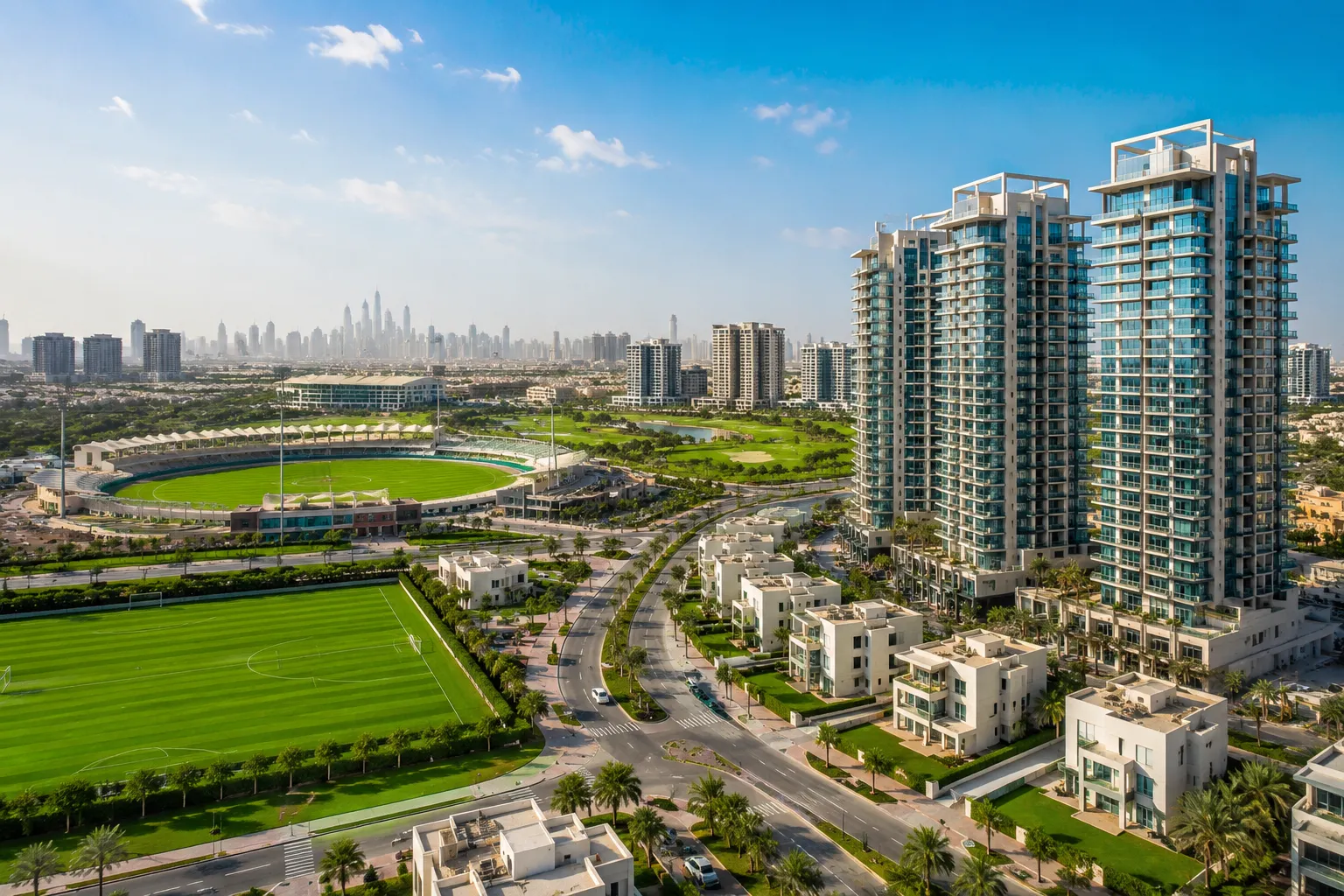
It is one of the most common questions serious buyers bring: should I buy a villa or an apartment? Both asset types have passionate advocates. Both have delivered strong returns in Dubai’s remarkable post-pandemic cycle. And both carry specific risks, costs, and exit dynamics that look very different when you model them honestly over a realistic five-year horizon.
The honest answer is that neither is universally better. The right choice depends on your entry budget, income requirements, risk tolerance, and what you actually need the investment to do over the Dubai property 5 year holding period you have in mind.
What follows is the most complete, data-grounded comparison we can offer between villa vs apartment Dubai investment across every dimension that actually determines long-term returns.
The Capital Appreciation Story: Where Villas Have Dominated
The headline number for Dubai villa returns over the past five years is striking. Average freehold villa values have risen approximately 206% since the pandemic across established communities. That is not a community-specific outlier. It is a market-wide pattern driven by structural supply shortage, end-user dominance, and family demand that has consistently outpaced the ability of developers to deliver new villa products.
Dubai apartment investment returns from capital appreciation have been more varied. Prime apartment locations including Downtown Dubai, Dubai Marina, and Palm Jumeirah have delivered strong gains. Apartment-heavy communities with significant new supply, particularly JVC, Business Bay, and Dubai South, have seen more moderate appreciation, and in some sub-segments, price per square foot has remained broadly flat over the same period.
The explanation for this divergence comes down to supply. New apartment towers can be built almost anywhere across Dubai’s vast land bank. New villa communities require large contiguous land parcels, extensive infrastructure investment, and years of construction. Once established villa communities are built out, new supply is genuinely constrained. That scarcity premium is embedded in Dubai villa returns and is expected to sustain as family demand continues to rise.
The Yield Story: Where Apartments Lead
Dubai rental yield villa apartment comparisons consistently show apartments ahead on gross yield. Here is the current picture across key communities and asset types:
| Property Type | Community | Average Gross Yield |
| Studio | DAMAC Hills | 16.13% |
| 1-Bedroom Apartment | DAMAC Hills | 13.18% |
| 1-Bedroom Apartment | JVC | 8.5% |
| 2-Bedroom Apartment | Dubai Marina | 6.5% |
| 3-Bedroom Villa | Dubai Hills Estate | 5.1% |
| 4-Bedroom Villa | Dubai Hills Estate | 5.6% |
| 5-Bedroom Villa | Arabian Ranches | 4.8% |
The yield advantage for Dubai apartment investment returns is real and consistent, particularly at the studio and one-bedroom level in accessible communities. Apartments offer lower entry prices, broader tenant pools, and faster leasing cycles that together produce higher gross returns on invested capital.
However, gross yield is not the number that determines your actual Dubai property 5 year holding return. Net yield after service charges, maintenance, vacancy, furnishing, and management fees is what reaches your bank account. And on a net basis, the gap between apartments and villas narrows considerably.
High-rise apartment buildings in communities like JVC and Business Bay carry service charges of AED 10 to 12 per square foot annually. Villa communities typically run AED 3 to 5 per square foot. For a 1,000 square foot apartment generating strong gross yield, the service charge alone can consume 1.5 to 2 percentage points of return before maintenance and vacancy are considered.
The Full Cost Comparison Over 5 Years
For a genuinely honest villa vs apartment Dubai investment comparison, total cost of ownership over the holding period matters as much as purchase price and yield.
| Cost Factor | Apartment | Villa |
| Entry Price Range | AED 500K to AED 3M | AED 2M to AED 15M+ |
| Service Charges | AED 10 to 12 per sq ft | AED 3 to 5 per sq ft |
| Furnishing Requirement | Higher for small units | Lower per sq ft |
| Maintenance Frequency | Shared with building | Owner-managed garden, pool |
| Vacancy Risk | Moderate in oversupplied areas | Lower in established communities |
| Tenant Turnover | Higher | Lower, longer leases typical |
Over a five-year period, a villa investor typically benefits from lower service charges, longer tenancies with less vacancy exposure, and reduced furnishing and management intensity. The apartment investor benefits from lower entry capital requirements and higher gross yield, but faces higher holding costs that erode net returns.
Dubai Capital Appreciation Property: The 5-Year Projection
Looking forward across a Dubai property 5 year holding horizon from 2026, the directional case for each asset type looks like this.
For Dubai villa returns, the supply constraint argument remains intact. Villa plot availability in established communities is genuinely finite. Dubai Hills Estate, Arabian Ranches, Tilal Al Ghaf, and comparable master communities have limited remaining development capacity. As family demand continues to grow, driven by population expansion, Golden Visa residency commitments, and the sustained preference for space and lifestyle that the post-pandemic era established, supply-constrained communities are positioned for continued Dubai capital appreciation property performance above market averages.
For Dubai apartment investment returns from capital appreciation, the picture is more community-specific. Prime waterfront apartment locations — Palm Jumeirah, Emaar Beachfront, Dubai Harbour — have structural scarcity arguments similar to villa communities. Mid-market apartment communities facing significant pipeline supply — JVC, Business Bay, Dubai South — are likely to see more modest price growth as 74,100 new completions scheduled for 2026 and a further 160,700 units projected for 2027 create meaningful competitive inventory.
Resale Liquidity: Which Is Easier to Exit?
Best property investment Dubai 2026 analysis must include exit strategy, not just entry returns. Liquidity at the point of sale is as important as appreciation during the holding period.
Apartments in established, well-known communities offer broader buyer pools. A one-bedroom in Dubai Marina or Downtown Dubai appeals to investors, end-users, corporate tenants, and international buyers simultaneously. This broad appeal typically translates into faster sale timelines when you choose to exit.
Villas in established communities offer deeper buyer pools in a different sense, more committed, higher-capital buyers who typically complete rather than withdraw. Villa transactions in communities like Dubai Hills Estate and Arabian Ranches have consistent secondary market activity that supports confident exit planning.
The relative liquidity challenge lies at opposite ends of each market. Highly generic apartments in oversupplied communities face the most exit risk as competing inventory compresses both sale prices and sale timelines. Ultra-large or heavily customised villas above AED 15 million face a narrower buyer pool by definition.
The Tax and Regulatory Environment
Both villa vs apartment Dubai investment decisions benefit from the same tax environment. Zero personal income tax, zero capital gains tax, zero rental income tax, and zero annual property tax apply equally to both asset types. The 4% Dubai Land Department transfer fee applies at purchase regardless of property type.
The Dubai rental yield villa apartment comparison is not distorted by differential tax treatment in Dubai in the way it would be in markets like the UK or Australia, where tax efficiency can genuinely shift the relative case for one asset type over another.
Which Profile Suits Which Asset?
| Investor Profile | Better Choice | Primary Reason |
| Yield-focused, lower budget | Apartment | Higher gross yield, lower entry |
| Long-term capital growth | Villa | Supply constraint, appreciation history |
| Family end-user with resale in mind | Villa | Lifestyle fit and long-term value |
| Short-term rental strategy | Apartment | Broader tourism tenant pool |
| Golden Visa and lifestyle | Villa | Space, community, residency anchor |
| First-time investor | Apartment | Lower commitment, broader liquidity |
| Portfolio builder | Both | Balance yield income with capital growth |
Villa vs apartment Dubai investment over a five-year holding period does not have a single correct answer. It has a correct answer for your specific financial situation, income requirements, risk tolerance, and exit horizon.
Dubai villa returns from capital appreciation have been superior over the past cycle and are structurally supported going forward by supply constraints and rising family demand. Net yield performance is respectable and improving as villa rents continue to rise.
Dubai apartment investment returns from yield are stronger, particularly at the entry-level end of well-located communities. But net yield after costs is considerably lower than gross figures suggest, and capital appreciation is increasingly community-specific rather than market-wide.
The most sophisticated approach for serious investors is portfolio thinking: apartments for immediate yield income and cash flow stability, villas for long-term capital growth and Dubai capital appreciation property performance. The combination delivers what neither asset type achieves alone in isolation.
At RGP Properties, we help clients model this decision with real numbers, real community data, and real exit scenarios rather than headline averages that do not reflect what your specific asset will actually deliver.
Contact RGP Properties today for a personalised best property investment Dubai 2026 analysis tailored to your budget, goals, and five-year strategy.
