

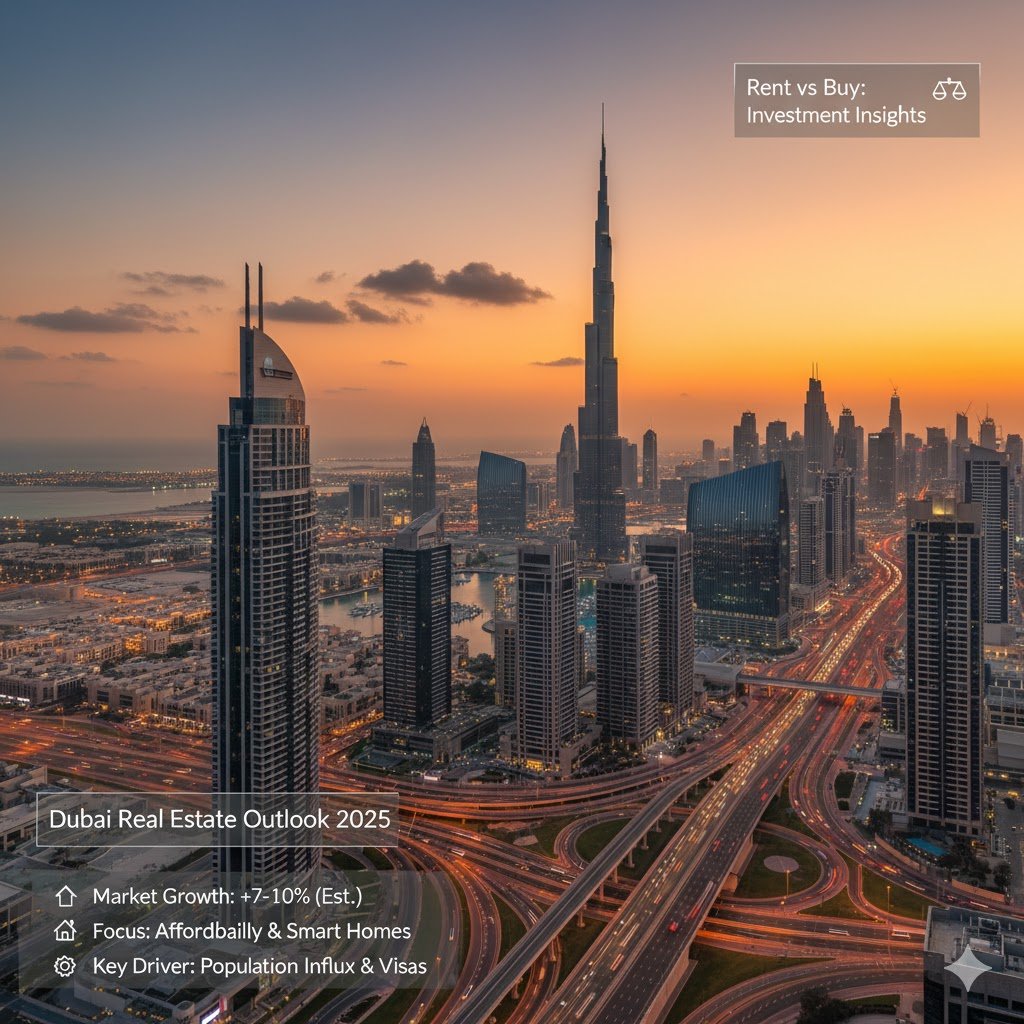
The decision between renting and buying a property in Dubai in 2025 is no longer a straightforward one. With prices, rental yields, and supply levels shifting rapidly, both investors and residents are rethinking what makes more financial sense in the current climate. Whether you are an expat looking for long-term stability or a professional evaluating short-term flexibility, understanding the financial and market realities of rent vs buy in Dubai 2025 can help you make a grounded decision.
Market Overview: The 2025 Landscape
Dubai’s property market has remained resilient throughout 2025, but signs of maturity and stabilization are visible. Residential property prices increased by approximately 15.8% year-on-year in Q1 2025, while rental rates rose by around 14.4% in the same period. Although growth remains strong, both sales and rental markets are showing early signs of cooling, with analysts predicting a gradual slowdown as more units come to completion.
Around 9,300 new units were delivered in the first quarter alone, and projections suggest nearly 73,000 additional residential units could enter the market by the end of the year. This increase in supply is expected to moderate the pace of price appreciation while keeping competition high among landlords.
Yields, however, remain robust. Apartments in Dubai currently deliver gross rental returns of about 7.3%, while villas average near 5%. These yields are among the most attractive globally, especially when combined with Dubai’s tax-free environment and business-friendly ecosystem.
However, not all analysts share unbridled optimism. Fitch Ratings forecast a potential correction of up to 15% by late 2025 or early 2026, citing oversupply risks and cooling investor demand. This does not necessarily spell danger for end-users but emphasizes the need for careful timing and financial clarity.
Cost Comparison: The Core of the Decision
When assessing rent versus buy, the conversation starts with the numbers. Buying in Dubai involves significant upfront costs. A typical down payment is around 20–30% of the property price, alongside a 4% Dubai Land Department transfer fee, 2% agency commission, valuation charges, mortgage registration fees, and other administrative costs.
Ongoing ownership costs include service charges, property maintenance, building insurance, and occasional repair expenses. For apartments, annual service charges can range between AED 12 to 30 per square foot, depending on the development.
Renting, on the other hand, requires a lower financial entry. Tenants typically pay the first rent installment, a refundable security deposit (5–10%), agent commission (around 5%), Ejari registration, and utilities deposit. These costs are manageable and, unlike purchase-related fees, don’t tie up significant capital.
However, the catch lies in recurring rent escalations. In 2025, rental hikes in popular communities such as Dubai Marina, Business Bay, and JVC range between 13% and 18%. While that number may taper slightly next year due to new supply, the long-term cost of renting continues to compound year after year.
Ownership, in contrast, offers a path to equity. Each mortgage payment builds ownership value in your property, offsetting a portion of monthly expenses. This long-term accumulation of equity makes buying financially rewarding for residents planning to stay for five years or more.
The Time Factor and Flexibility
One of the strongest arguments in favor of renting is flexibility. Dubai remains a highly dynamic city with an ever-evolving professional and social landscape. Many expatriates relocate frequently, making a long-term mortgage commitment less practical.
If you plan to live in Dubai for one to three years, renting often remains the better choice. The upfront costs and transaction friction of purchasing outweigh any short-term capital appreciation. For stays exceeding five years, however, buying begins to look financially stronger, as cumulative rent payments can surpass ownership costs, especially when factoring in the potential for capital gains and long-term equity buildup.
Moreover, lifestyle plays a role. Renters enjoy the ability to move neighborhoods, upgrade or downsize, and respond to job or family changes without being tied down. Buyers trade some of that flexibility for security, predictability, and stability.
Risk and Market Behavior
Despite Dubai’s robust fundamentals, market risk remains a critical consideration. Analysts expect a modest correction phase between late 2025 and mid-2026, primarily driven by supply expansion. If prices dip by 10–15%, recent buyers could see their property values decline in the short term.
However, long-term buyers typically weather such cycles with ease, as Dubai’s infrastructure development, population growth, and consistent investor demand tend to restore values over time.
The rental market also faces shifts. As thousands of new units are handed over, certain districts may experience slower rental growth or even temporary dips. This makes location research vital: emerging areas with limited new supply or strong tenant demand, such as Dubai Hills Estate, MBR City, and Al Wasl, may maintain stronger pricing resilience.
Measuring Financial Viability
Several metrics can help quantify which option makes more sense:
The Price-to-Rent Ratio divides the average property price by annual rent. A lower ratio (around 15–17) suggests buying may be financially smarter, while a higher ratio favors renting. In Dubai, this ratio varies widely by area but generally hovers near the tipping point.
The 4% Rule compares the total annual cost of owning including interest, fees, and maintenance, to 4% of the property value. If the cost of ownership exceeds that threshold, renting becomes the more economical choice.
The 30% Rule measures affordability: if monthly mortgage and related expenses exceed 30% of your gross income, renting may offer healthier financial balance.
To illustrate, consider a 1-bedroom apartment in Dubai Marina. Renting such a unit over five years would cost around AED 525,000 in total rent. Buying the same property with a mortgage could cost roughly AED 1.09 million over five years, including upfront and ongoing expenses, but around AED 560,000 of that amount would contribute directly toward building ownership equity. Over time, this equity offsets higher initial spending and provides a tangible asset that could appreciate or be leveraged later.
Non-Financial Dimensions
Financial analysis alone rarely captures the full picture. Buying brings a sense of permanence and control, you can renovate, modify, and personalize your space without needing landlord approval. It also protects against future rent inflation and offers a stable housing cost structure over decades.
Renting, meanwhile, eliminates the burden of maintenance, service charges, and long-term commitment. Tenants can upgrade to new communities, explore lifestyle changes, or relocate internationally without the complexity of selling a property.
Another factor is residency. Certain property purchases can qualify buyers for long-term residence visas, including investor visas or 10-year Golden Visas, depending on investment value. This additional benefit strengthens the ownership argument for those seeking stability in the UAE.
Lifestyle considerations, family planning, and financial discipline all influence which choice aligns best with your circumstances. Ownership requires careful budgeting and patience; renting offers ease and adaptability.
Final Perspective
The rent vs buy decision in Dubai 2025 is not about choosing right or wrong, it’s about aligning financial logic with personal priorities. In a high-yield, low-tax environment, buying holds strong appeal for long-term residents who view real estate as a stable investment. Yet for transient professionals or those uncertain about future plans, renting remains a financially prudent and flexible approach.
Dubai’s property market has matured into a more transparent and regulated ecosystem, offering both renters and buyers clear advantages depending on their objectives. As the city moves through another cycle of expansion, the smartest decision may lie in balancing financial analysis with practical foresight.
